Brazilian Scientists Solve 50-Year-Old Fossil Enigma with Discovery of New Plant Genus Franscinella
By Yuvraj Singh
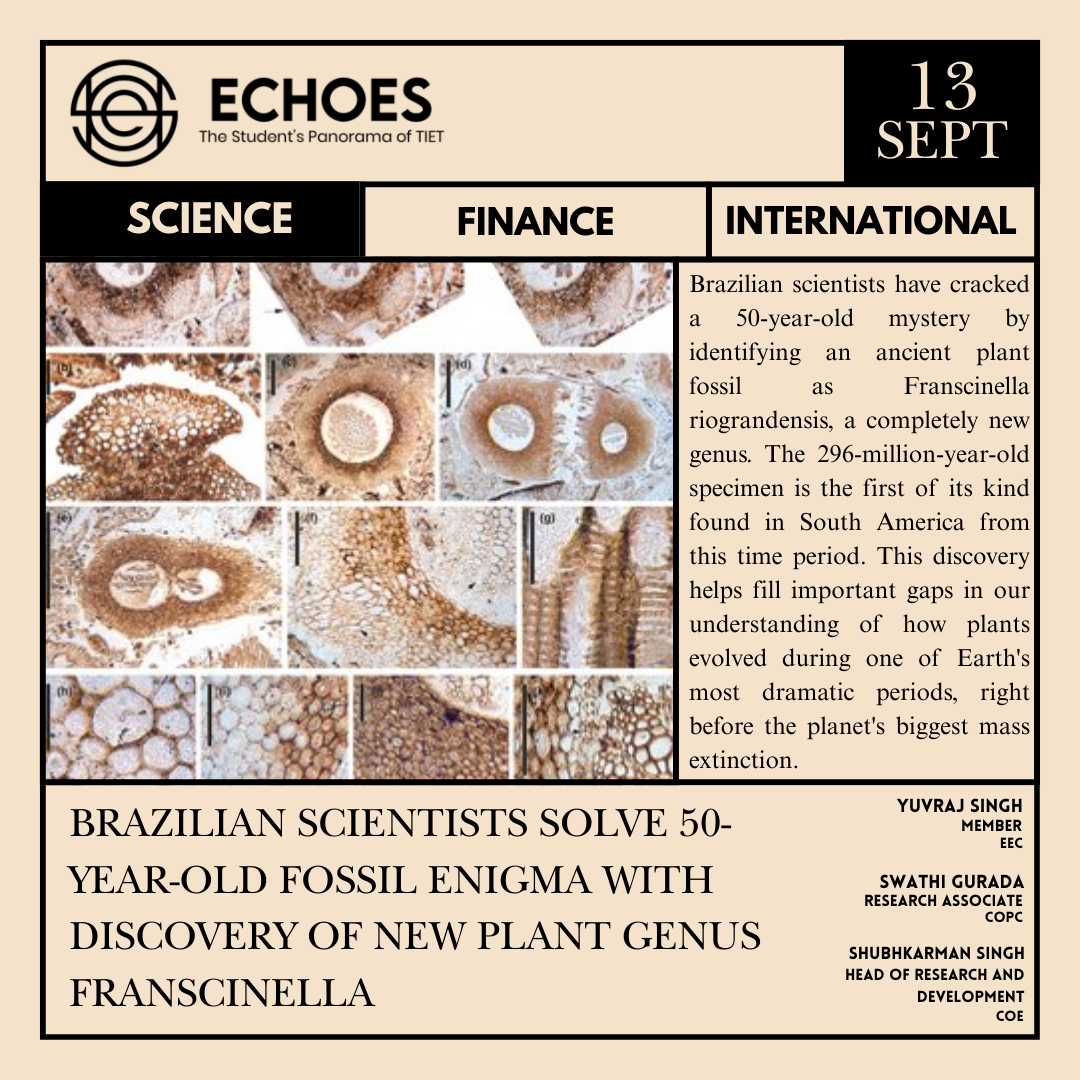
Franscinella riograndensis: A Paleobotanical Breakthrough in Brazil
In a groundbreaking paleobotanical breakthrough, researchers from Brazil have successfully identified and
classified a mysterious 296-million-year-old plant fossil, establishing a new genus called
Franscinella riograndensis.
This discovery, published in recent scientific literature, resolves a half-century-old enigma that has
puzzled scientists since the fossil was first unearthed in southern Brazil's Paraná Basin during the
1970s.
The fossil, originally discovered decades ago, had remained an unidentified specimen in collections until
advanced analytical techniques allowed researchers to unlock its secrets.
This new classification represents the first recorded evidence of lycopsids with in situ spores from the
Permian period in the Paraná Basin, making it a crucial piece in understanding ancient plant evolution.
Unlocking Ancient Mysteries Through Modern Science
The research team utilized cutting-edge microscopy and paleobotanical analysis to examine the fossil's
cellular structure and reproductive organs in unprecedented detail.
The specimen exhibits characteristics that clearly distinguish it from previously known plant species,
warranting the establishment of an entirely new genus.
Franscinella riograndensis belongs to the lycopsids, an ancient group of vascular plants
that dominated Earth's landscapes during the late Paleozoic Era.
The discovery provides several key insights:
Key Insights from the Discovery
- Evolutionary Significance: The fossil fills critical gaps in our understanding of plant evolution during the Permian period, a time of major environmental transitions that preceded the largest mass extinction in Earth's history.
- Paleoclimatic Insights: The presence of lycopsids in the Paraná Basin suggests specific environmental conditions existed 296 million years ago, helping scientists reconstruct ancient climate patterns and ecosystem dynamics.
- Biogeographic Patterns: This discovery provides the first concrete evidence of lycopsid diversity in South America during the Permian, expanding our knowledge of how these plants were distributed across the ancient supercontinent Pangaea.
Bridging Past and Present
The identification of Franscinella demonstrates how modern scientific techniques can
breathe new life into historical discoveries.
Advanced imaging technologies and refined classification methods allowed researchers to:
- Analyze microscopic details: Examination of spore structures and cellular organization that were impossible to study with earlier technology.
- Comparative studies: Cross-reference with global fossil databases to confirm the uniqueness of the specimen.
- Interdisciplinary collaboration: Combine expertise from paleobotany, geology, and evolutionary biology to provide comprehensive analysis.
This research exemplifies how patient scientific investigation can eventually solve even the most persistent mysteries, transforming decades-old questions into breakthrough discoveries that enhance our understanding of life's evolutionary history.
Sources: scitechdaily.com , phys.org, univates.br