Decoding the Sun: India’s Aditya-L1 Joins Forces with Europe’s Proba-3
By Madalsa Sehgal
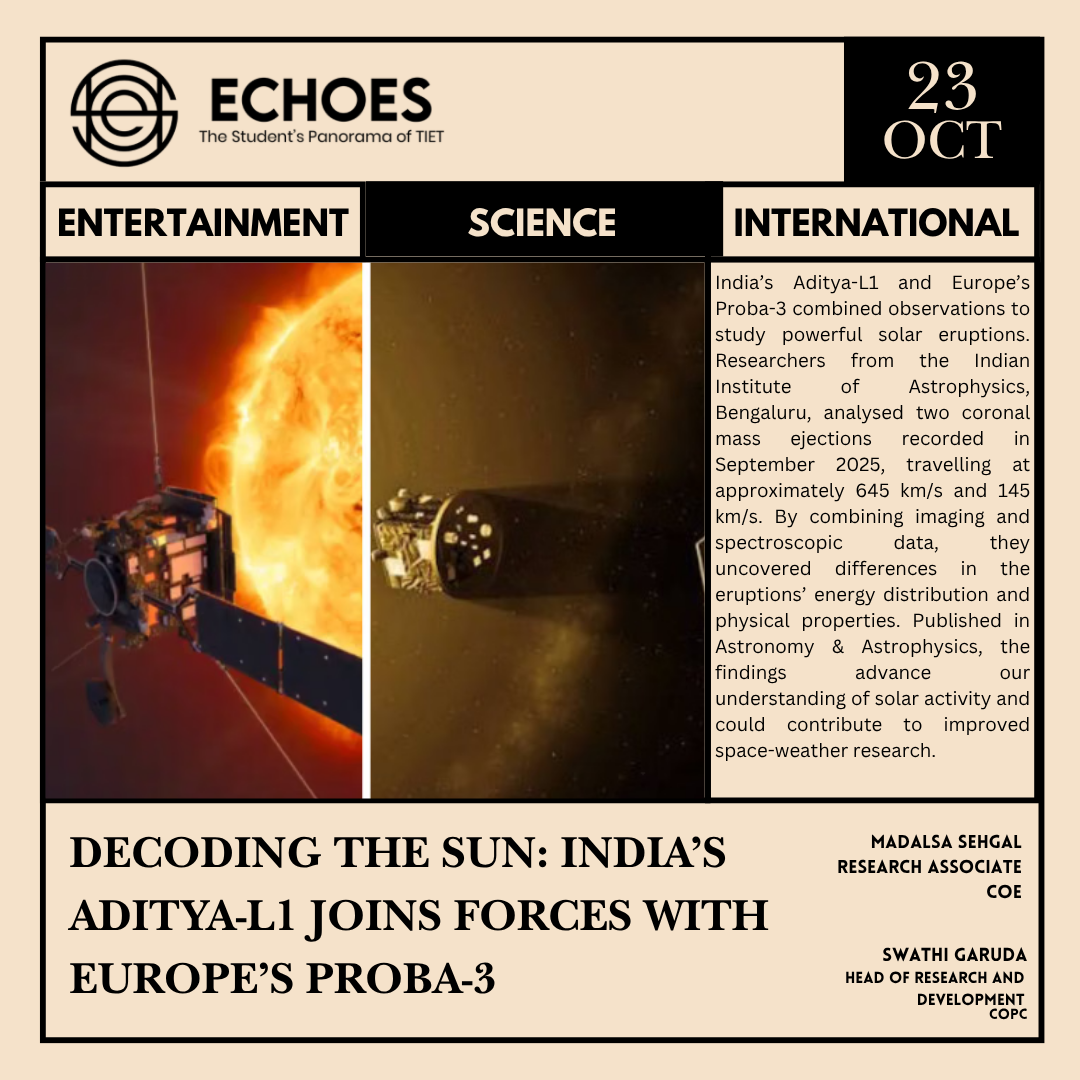
The Sun may appear constant from Earth, but its atmosphere is highly dynamic. It frequently releases massive bursts of charged particles and magnetic fields, known as coronal mass ejections (CMEs). When directed towards Earth, these eruptions can disrupt satellites, communication systems and navigation technologies, making their study crucial to understanding space weather.
In a significant development, scientists from the Indian Institute of Astrophysics (IIA), Bengaluru, combined observations from India’s Aditya-L1 mission and the European Space Agency’s Proba-3 mission to investigate these eruptions. Announced by ISRO on 15 October 2026, the research was published in Astronomy & Astrophysics.
The two missions offer complementary perspectives of the Sun. Aditya-L1’s VELC instrument studies the properties of the solar corona, while Proba-3’s ASPIICS instrument captures detailed images of this faint region using an artificial solar eclipse created by two spacecraft flying in formation.
Researchers analysed two solar eruptions observed in September 2025, travelling at approximately 645 km/s and 145 km/s, respectively. The events displayed different energy patterns, revealing how heat, motion and magnetic fields contribute differently to solar eruptions.
The findings demonstrate how combining observations from multiple spacecraft can improve our understanding of the Sun’s behaviour. This research could contribute to better scientific models of solar activity and its effects on Earth, while highlighting the importance of international collaboration in advancing space science.
Summary: India’s Aditya-L1 and Europe’s Proba-3 have combined observations to study powerful solar eruptions. Researchers from the Indian Institute of Astrophysics, Bengaluru, analysed two coronal mass ejections recorded in September 2025. The eruptions travelled at approximately 645 km/s and 145 km/s, displaying different energy patterns. By combining images and spectroscopic data, scientists gained deeper insights into their physical properties. Published in Astronomy & Astrophysics, the research highlights the value of international collaboration in understanding solar activity and space weather.
Sources: isro.gov.in, nature.com, theprint.in, aanda.org