India to Induct Pralay: DRDO Successfully Test-Fires Indigenous Quasi-Ballistic Missile
By Sarang Gulati
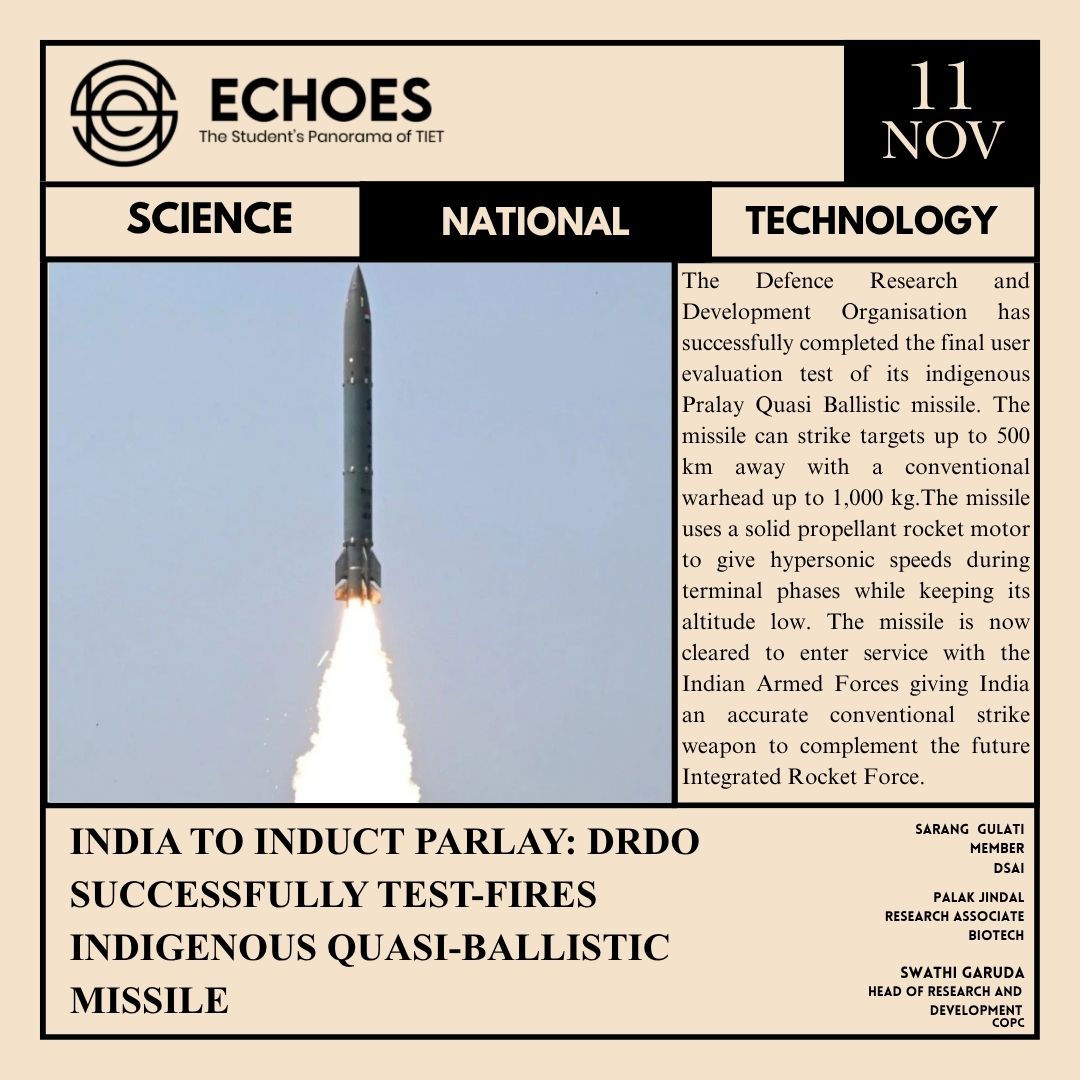
The Defence Research and Development Organisation (DRDO) successfully conducted the final flight trial of its indigenous surface to surface Quasi-Ballistic Missile ‘Pralay’ on 5th November 2026 from the Integrated Test Range at Dr APJ Abdul Kalam Island, Odisha. The missile successfully performed all mission parameters with high accuracy, under the guidance of telemetry, radar, and electro optical tracking systems. The test clears the missile to enter service with the Indian Army and Air Force.
Unlike traditional ballistic missiles which have a predictable parabolic flight path through the upper atmosphere and can be targeted by modern air defence radars, the Pralay utilises a ‘quasi-ballistic’ approach. The missile uses a high thrust solid propellant rocket motor to keep its altitude much lower during flight. The missile performs dynamic flight manoeuvres while diving at hypersonic speeds of Mach 6.1 with its jet vane thrust vector control system to avoid enemy Surface to Air Missiles such as China’s HQ-9.
The missile was developed by the Research Centre Imarat (RCI) and DRDO’s nodal labs. Designed for striking targets up to 500 km away, the missile can carry 350 kg to 1,000 kg of conventional warhead. These include High Explosive Pre-Fragmented (HEPF), Penetration Cum Blast (PCB) and runway denial munitions. The missile uses sophisticated Inertial Navigation System (INS) and MMW seeker technology to achieve a Circular Error Probability (CEP) of less than 10m. This allows accurate strikes with no deviation.
Operationally, the missile helps fill a gap in India’s northern and western borders. As the Agni and Prithvi ballistic missiles operate under India’s strict No First Use policy, the missile is purely a conventional projectile allowing forces to strike enemy supply depots, command posts, fuel stores and mountain airbases across the Line of Actual Control (LAC) and Line of Control (LoC).
The missile is produced by Bharat Dynamics Limited and can be transported on highly mobile 12x12 Multi-Axle Transporter Erector Launchers (TEL). Once ordered by the armed forces, this missile will form part of the Integrated Rocket Force (IRF) with the supersonic BrahMos and Pinaka multi-barrel rocket systems.
Summary: The Defence Research and Development Organisation has successfully completed the final user evaluation test of its indigenous Pralay Quasi Ballistic missile. The missile can strike targets up to 500 km away with a conventional warhead up to 1,000 kg. The missile uses a solid propellant rocket motor to give hypersonic speeds during terminal phases while keeping its altitude low. The missile is now cleared to enter service with the Indian Armed Forces giving India an accurate conventional strike weapon to complement the future Integrated Rocket Force.
Sources: drdo.gov.in, pib.gov.in,