Can India Grow Fast While Inflation Rises?
By Hiya Kasturia
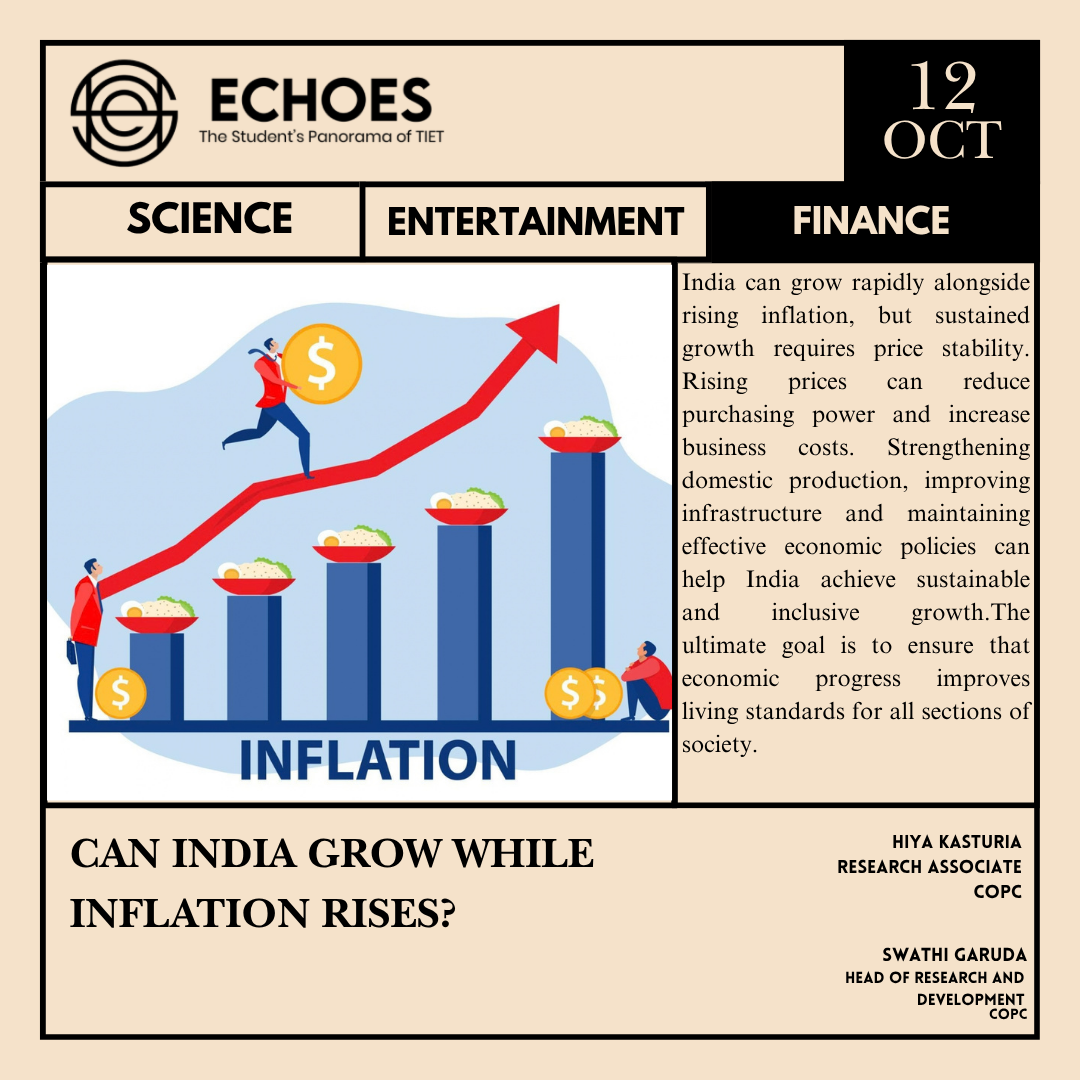
Economic growth and inflation often move together, creating a challenge for policymakers. As an economy expands, demand for goods, services, labour and raw materials increases, sometimes pushing prices upward. For India, one of the world's major emerging economies, the question is not simply whether growth can continue alongside rising inflation, but whether that growth can remain sustainable and inclusive.
Economic growth refers to an increase in the production of goods and services, generally measured through Gross Domestic Product (GDP). Inflation, meanwhile, refers to a sustained increase in the general price level, reducing the purchasing power of money. Moderate inflation can accompany a growing economy, as rising consumer demand encourages businesses to expand production, invest in infrastructure and hire more workers. However, when demand grows faster than the economy's capacity to supply goods and services, prices can rise rapidly. Inflation can also result from supply-side pressures, such as higher crude oil prices, poor harvests and disruptions in global supply chains.
India's economic performance demonstrates the potential for strong growth alongside relatively stable prices. According to the Government of India's Economic Survey 2025-26, real GDP growth was estimated at 7.4% for FY2025-26, while retail inflation averaged 1.7% during April-December 2025. Domestic consumption, public infrastructure investment, manufacturing and services remain important drivers of economic activity. However, inflationary pressures can re-emerge when essential commodities become expensive or global uncertainty raises import costs. India's dependence on imported crude oil makes the economy particularly vulnerable to fluctuations in international energy prices.
The consequences of inflation extend beyond economic statistics. When food, transport, housing and other essentials become more expensive, households have less money available for savings and discretionary spending. Lower-income families are particularly vulnerable because essential goods account for a larger share of their expenditure. Businesses also face higher production costs, which can reduce profit margins or lead to further price increases. If inflation remains elevated, the Reserve Bank of India may increase interest rates to moderate demand and contain price pressures. Although this can help stabilise prices, borrowing becomes more expensive for businesses and households, potentially slowing investment and consumption.
India's challenge is to expand its productive capacity while maintaining price stability. Investment in agriculture, storage facilities, transport networks and renewable energy can reduce supply bottlenecks and dependence on volatile imports. Encouraging manufacturing, improving logistics and creating skilled employment can help production keep pace with demand. Monetary policy also plays a crucial role, as the Reserve Bank of India must balance inflation control with the need to support economic activity. Meanwhile, targeted government support can help vulnerable households manage rising living costs.
Summary: India can achieve rapid economic growth alongside rising inflation, but sustained progress requires a careful balance between the two. Economic expansion increases consumption, investment and employment, while excessive demand or supply disruptions can push prices upward. India's estimated 7.4% real GDP growth in FY2025-26, alongside average retail inflation of 1.7% during April-December 2025, illustrates that strong growth and low inflation can coexist. However, persistent inflation reduces purchasing power, increases business costs and may prompt higher interest rates. Strengthening agriculture, manufacturing, infrastructure and supply chains, alongside effective monetary policy, can help India maintain stable prices while pursuing inclusive, sustainable economic growth.
Sources: Economic Survey 2025-26, Press Information Bureau, Ministry of Statistics and Programme Implementation