When Humans Sound Like Birds: How Human Speech and Song Echo the Patterns of Birdsong
By Mitisha Sardana
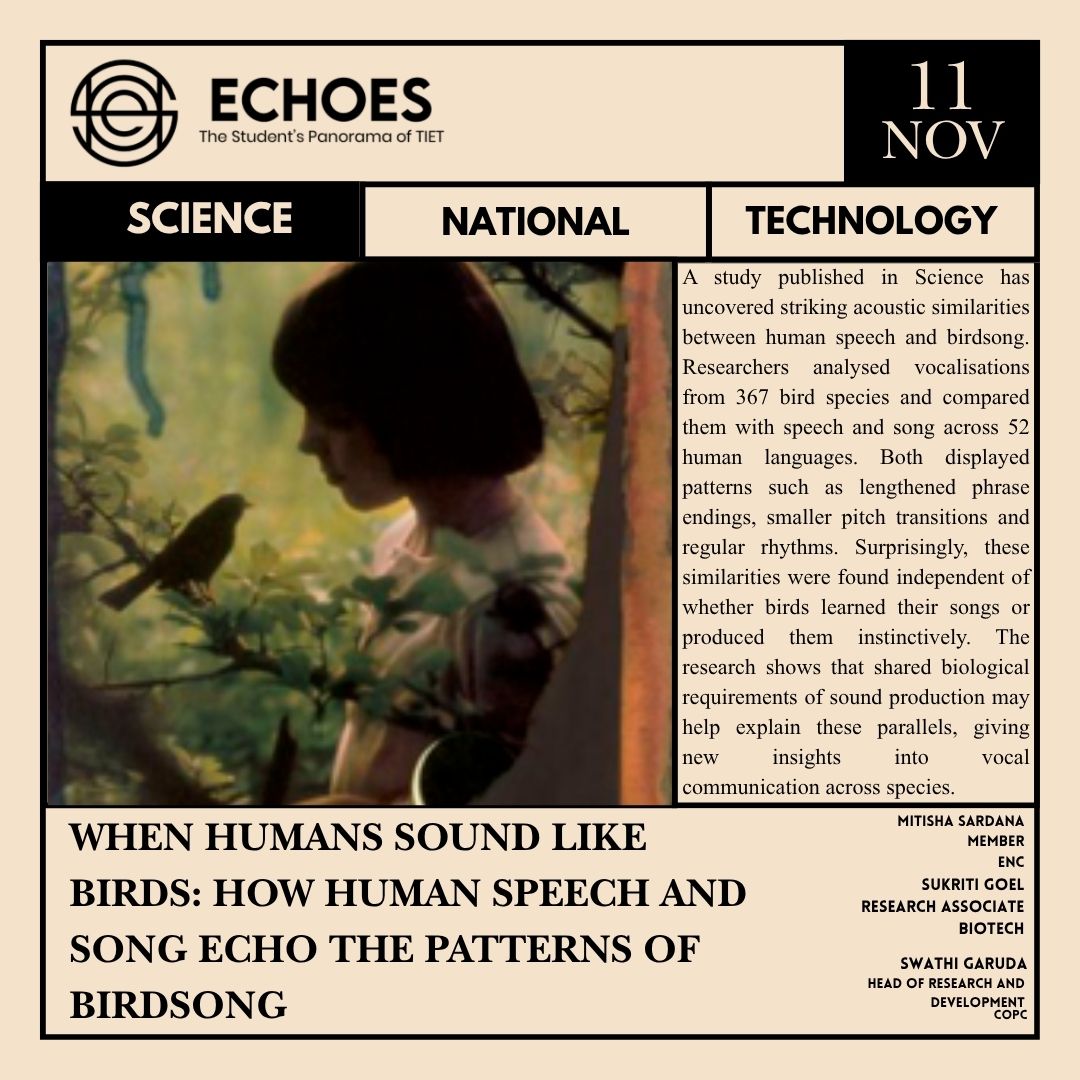
A bird sings, and we call it a song. A human speaks, and we call it language. We have given these sounds different names, studied them in different ways, and placed them in entirely different categories. Yet what if the distinction isn't as clear as we have always imagined? What if, beneath a bird's chirps and the syllables of a conversation, both share a rhythm?
A recent study published in the journal Science on 29 October 2026, by researchers from McGill University and collaborating institutions, set out to explore precisely this connection. Analysing vocalisations from 367 bird species and comparing them with speech and song across 52 human languages, they studied whether two seemingly distant forms of communication might follow some of the same acoustic patterns.
There was an interesting question at the heart of their investigation. Humans learn to speak by listening, observing and imitating. Several bird species learn their songs in much the same way. Could this shared ability to learn vocalisations explain the similarities between them? Researchers expected birds that learn their songs to display patterns more closely resembling human speech than those whose vocalisations are largely instinctive.
But the findings suggested otherwise.
Both humans and birds showed a tendency to lengthen the final sound in a phrase, favour relatively small changes in pitch between consecutive sounds, and follow regular, predictable rhythms. More surprisingly, these similarities were also found in birds that do not learn their songs. The resemblance, it seemed, went beyond the process of learning.
So, what brings these different voices together?
Researchers suggest that some of these similarities may arise from the biological requirements of producing sound. Both humans and birds must coordinate airflow with the muscles involved in vocalisation. These shared physical demands may influence how sounds are arranged, sustained and connected. While this explanation is not entirely proven, it offers a new way of perceiving the foundations of vocal communication.
Of course, a bird’s song is not a human conversation, and a shared rhythm does not mean a shared language.
But perhaps the most interesting possibility lies beyond the similarities themselves. If science can begin to recognise the patterns governing birdsong, could it eventually move towards understanding the messages hidden within it? Could the rhythms, pitches and sequences we are only beginning to decode give us clues to what birds communicate, and perhaps even help us to understand a world of conversations that has always existed around us, largely unnoticed?
We have spent centuries listening to birds. Perhaps the next step is learning how to understand them.
Summary: A study published in Science has uncovered striking acoustic similarities between human speech and birdsong. Researchers analysed vocalisations from 367 bird species and compared them with speech and song across 52 human languages. Both displayed patterns such as lengthened phrase endings, smaller pitch transitions and regular rhythms. Surprisingly, these similarities were found independent of whether birds learned their songs or produced them instinctively. The research shows that shared biological requirements of sound production may help explain these parallels, giving new insights into vocal communication across species.
Sources: University of British Columbia, PubMed,