India Goes Critical: The Reactor That Breeds Its Own Fuel Just Changed History
By Vekhyat Jain
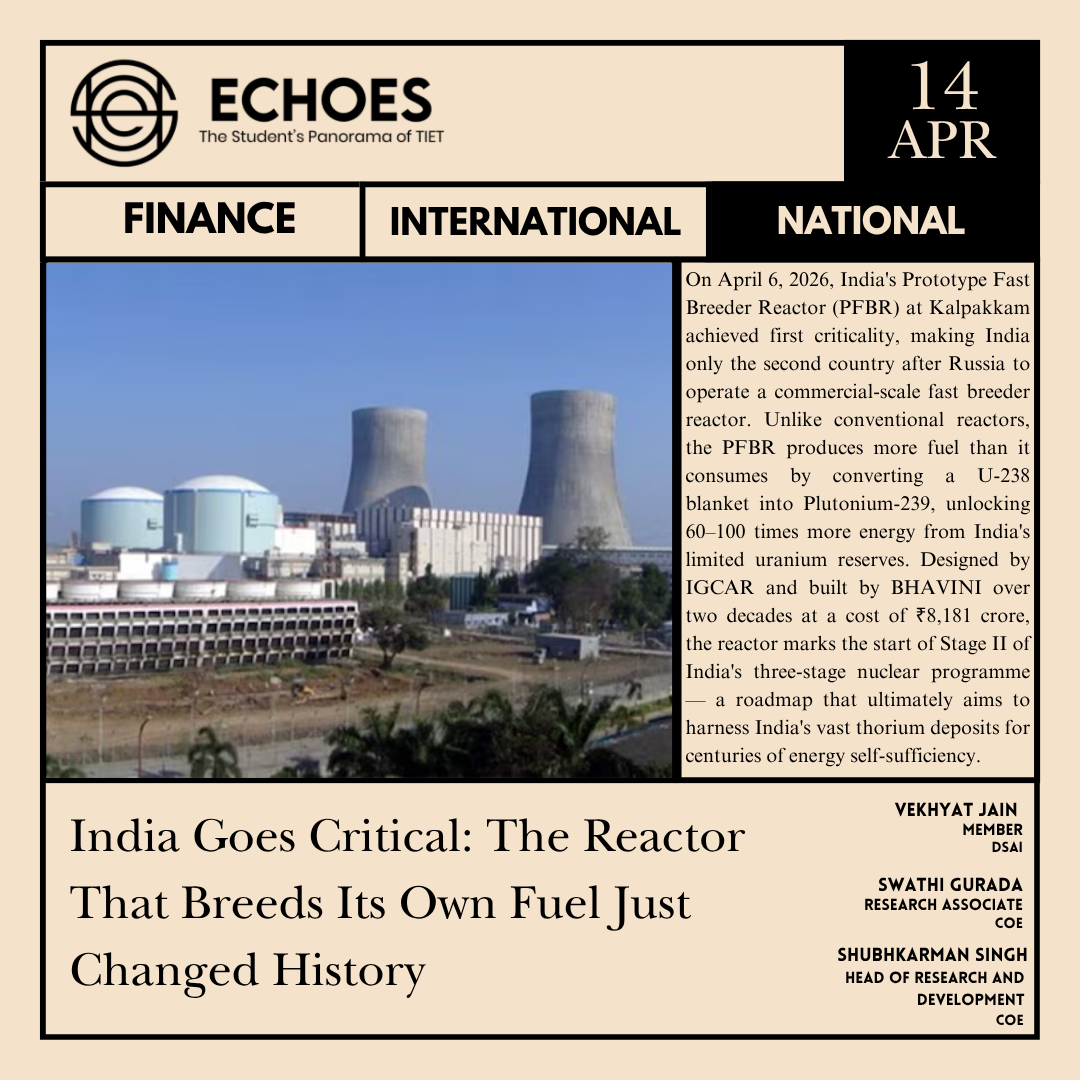
The Moment
At 8:25 PM on April 6, 2026, a reactor on the Tamil Nadu coastline quietly changed the course of India's energy future. The 500 MWe Prototype Fast Breeder Reactor (PFBR) at Kalpakkam achieved first criticality — the point at which a nuclear chain reaction becomes fully self-sustaining — placing India in an exclusive club alongside just one other nation on the planet.
What Makes It Extraordinary
A fast breeder reactor does something almost counterintuitive: it produces more fissile fuel than it consumes. The PFBR's core, loaded with Uranium-Plutonium Mixed Oxide (MOX) fuel, is surrounded by a blanket of Uranium-238. Fast neutrons bombard this blanket and convert it into Plutonium-239 — usable fuel for the next generation of reactors. In effect, the reactor manufactures its own feedstock while simultaneously generating electricity.
India's Three-Stage Plan
The achievement signals the start of Stage II of India's three-stage nuclear programme — a plan conceived by physicist Homi J. Bhabha in the 1950s. India holds limited uranium reserves, but sits on one of the world's largest thorium deposits along its coastline. The three-stage architecture was designed to eventually unlock that thorium wealth, using each stage's output to fuel the next, ending in a self-sustaining thorium economy that could power India for centuries.
Stage I uses Heavy Water Reactors (already operational) to generate
electricity and produce plutonium as a by-product.
Stage II — now live — uses that plutonium in fast breeder reactors to
generate more fuel than is consumed.
Stage III will eventually use thorium-232 converted into
uranium-233 to power an entirely indigenous, uranium-independent fuel cycle.
A Global First (Nearly)
With the PFBR achieving criticality, India becomes only the second country in the world after Russia to operate a commercial-scale fast breeder reactor. The reactor was designed entirely in India by the Indira Gandhi Centre for Atomic Research (IGCAR) and built by Bharatiya Nabhikiya Vidyut Nigam Ltd. (BHAVINI), both under the Department of Atomic Energy. Over 200 Indian industries, including MSMEs, contributed to its construction — a landmark for Aatmanirbhar Bharat in deep-tech manufacturing.
Two Decades in the Making
Construction began in 2004 with a target completion of 2010. Technical challenges — most notably a problem with the fuel-handling machine operating inside opaque liquid sodium coolant where direct inspection is impossible — caused cascading delays. Engineers at IGCAR designed and fabricated an entirely new handling flask in under five months, eventually receiving AERB clearance to resume core loading in October 2025. The project cost rose from ₹3,492 crore to over ₹8,181 crore over its two-decade journey.
What Comes Next
First criticality is the starting gun, not the finish line. The PFBR will now undergo phased power ascension, performance testing, and safety validation before connecting to the national grid for commercial electricity generation. Success here paves the way for larger 600 MWe fast breeder reactors and ultimately for Stage III thorium reactors. For a country with just 8.78 GW of nuclear capacity against a peak demand of 242 GW, April 6 marks a turning point — not in kilowatts delivered today, but in the trajectory set for 2047 and beyond.
Sources: dae.gov.in , ddnews.gov.in, aljazeera.com