From Code to Conscious Movement: The Evolution of Intelligent Robots
By Girisha Raheja
For decades, robots have been designed to follow instructions, repeat programmed actions and perform tasks with precision. But what if a robot could do more than simply follow a command? What if it could understand an objective, figure out how to achieve it and adapt along the way? This is where Agentic AI begins to reshape the possibilities of robotics.
Unlike conventional AI systems that primarily respond to instructions, Agentic AI can independently break down objectives, plan multiple steps, make decisions and evaluate its progress. When integrated with robotics, these capabilities gain a physical dimension. Cameras and sensors help machines perceive their surroundings, AI models interpret what they see, and mechanical components translate those decisions into movement.
Imagine instructing a robot to prepare a room for a meeting. Instead of following a fixed sequence of commands, it could identify misplaced objects, organise the space, arrange furniture and adapt its actions if something unexpected happens. The ability to understand an objective rather than simply execute individual commands marks a significant shift in robotic capabilities.
This transition is already taking shape. In July 2026, Google DeepMind introduced Gemini Robotics 2, featuring whole body control, advanced dexterity and multi-robot collaboration. Its companion reasoning model, Gemini Robotics ER 2, enables robots to understand physical environments, plan complex tasks and monitor their progress. Similarly, NVIDIA's Isaac GR00T platform brings together foundation models, simulation tools and training workflows to help developers build general-purpose humanoid robots.
Beyond industrial applications, this convergence also opens up possibilities for personalised robotic counterparts. Imagine machines that learn from human demonstrations, adapt to individual preferences and gradually become capable of assisting with tasks in ways tailored to their users.
The fascinating part is that we are no longer looking at machines that simply perform actions we programme into them. We are beginning to explore machines that can understand a goal, figure out the steps themselves and physically bring those decisions to life. It is a shift from building robots that do what we tell them to building robots that can work out how to do it.
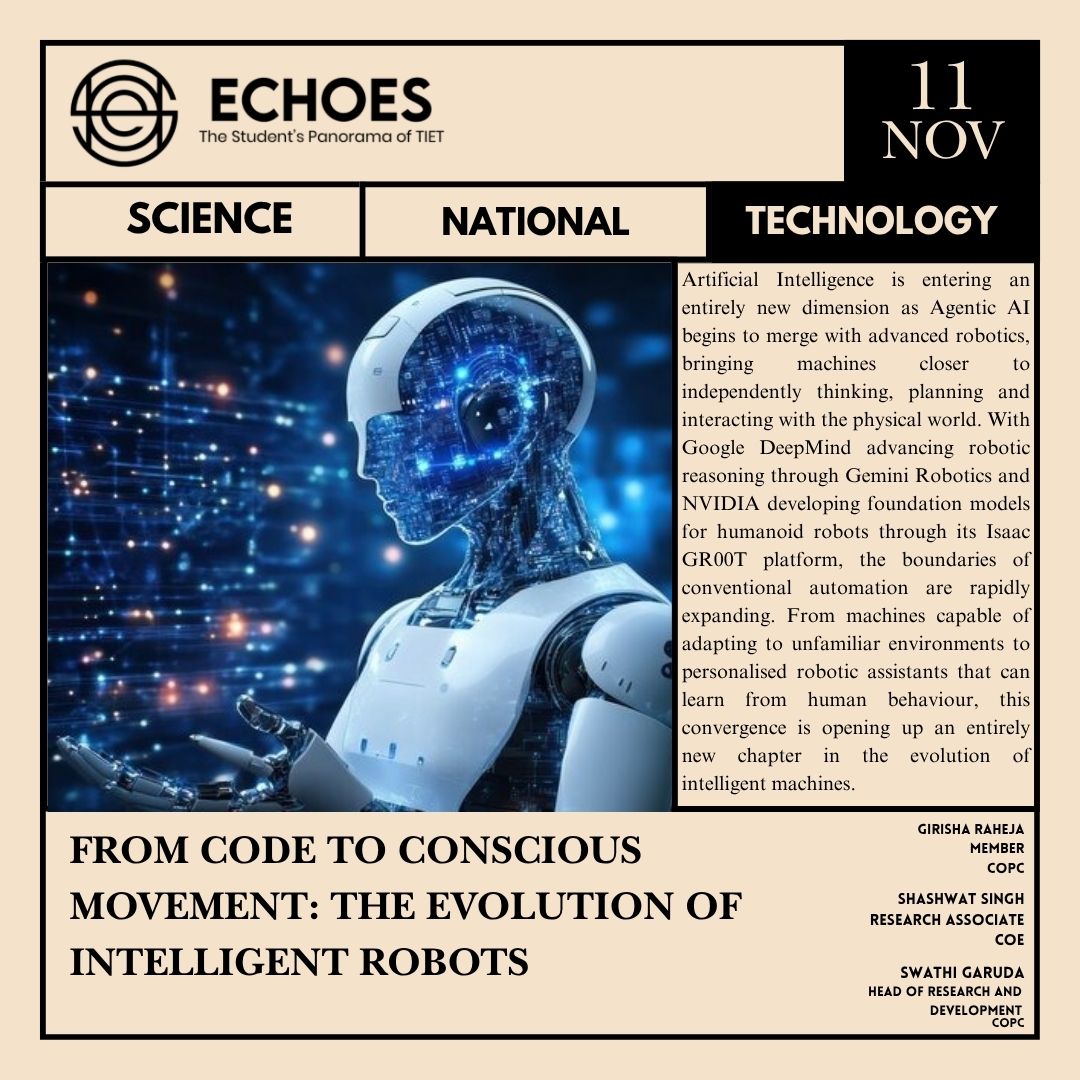
Summary: Artificial Intelligence is entering an entirely new dimension as Agentic AI begins to merge with advanced robotics, bringing machines closer to independently thinking, planning and interacting with the physical world. With Google DeepMind advancing robotic reasoning through Gemini Robotics and NVIDIA developing foundation models for humanoid robots through its Isaac GR00T platform, the boundaries of conventional automation are rapidly expanding. From machines capable of adapting to unfamiliar environments to personalised robotic assistants that can learn from human behaviour, this convergence is opening up an entirely new chapter in the evolution of intelligent machines.
Sources: Deepmind, nvidia.com