Shining Light on the Mind: Optogenetics Trio wins 2026 Nobel Prize
By Sukriti Goel
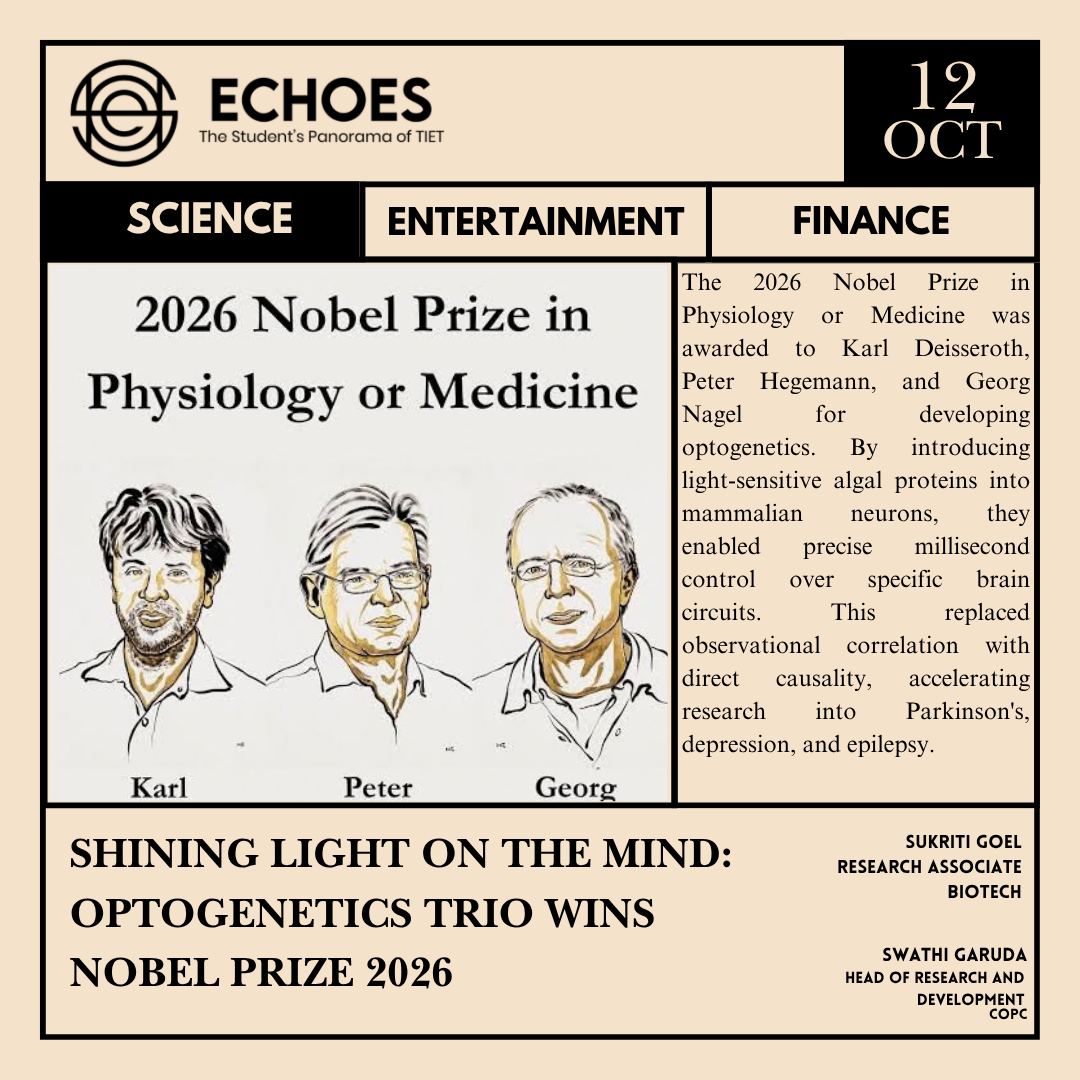
The 2026 Nobel Prize in Physiology or Medicine was awarded to Karl Deisseroth (Stanford University), Peter Hegemann (Humboldt University of Berlin), and Georg Nagel (University of Würzburg) for their revolutionary discoveries concerning light-gated ion channels and the development of optogenetics. The total prize of 11 million Swedish kronor is shared among the three laureates for providing neuroscience with a transformative molecular remote control over living brain cells.
The foundation of this breakthrough began when biophysicists Hegemann and Nagel identified channel rhodopsins—light-sensitive proteins in single-celled green algae that open as rapid ion channels when struck by light. Building on this discovery, Deisseroth pioneered the technique to genetically engineer mammalian neurons to express these algal proteins. By delivering precise wavelengths of light via optical fibers directly into targeted brain tissue, researchers gained the unprecedented ability to switch specific electrical signals and neural circuits on or off within milliseconds.
This achievement bridged a long-standing gap in neuroscience by replacing observational correlation with direct causality. Previously, neuroscientists relied on observational recording methods (like EEG or fMRI) or non-specific interventions (like electrical stimulation and systemic pharmaceuticals). While these older tools could show a correlation between brain region activity and a function, they lacked cellular precision and often affected wide swathes of neighboring tissue, making it impossible to prove direct cause and effect. Optogenetics fundamentally solved this by allowing scientists to manipulate single cell types while leaving adjacent neurons intact, definitively proving how specific circuits directly cause complex behaviors, memory formation, and psychiatric symptoms. Today, optogenetics accelerates critical research into conditions like Parkinson’s disease, epilepsy, depression, and schizophrenia, while opening new avenues for vision restoration and gene therapy.
Summary: The 2026 Nobel Prize in Physiology or Medicine was awarded to Karl Deisseroth, Peter Hegemann, and Georg Nagel for developing optogenetics. By introducing light-sensitive algal proteins into mammalian neurons, they enabled precise millisecond control over specific brain circuits. This replaced observational correlation with direct causality, accelerating research into Parkinson's, depression, and epilepsy.