Rising Friction between China and The Philippines in the South China Sea
By Palak Jindal
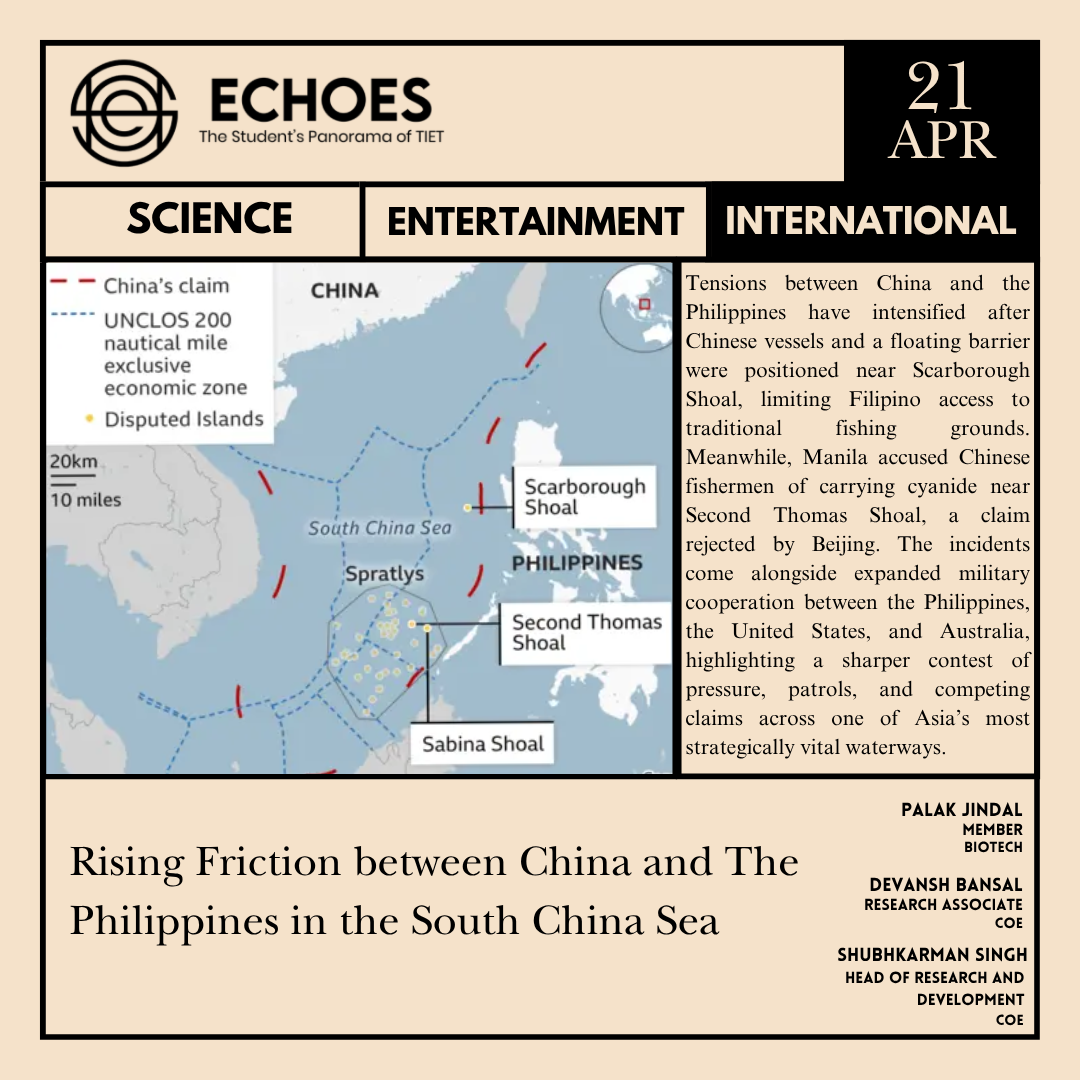
Rising Tensions in the South China Sea
Recent tensions between China and the Philippines have intensified after allegations that Chinese vessels restricted access near Scarborough Shoal. Beijing denied the claims and defended its presence in the contested waters. These incidents come at a time of expanding military cooperation between the Philippines, the United States, and Australia, showing how the South China Sea dispute is now being shaped by both maritime pressure tactics and growing alliances.
Developments Near Scarborough Shoal
On 15 April 2026, satellite imagery showed Chinese vessels and a floating barrier positioned near the entrance to Scarborough Shoal, a resource-rich fishing ground claimed by both Beijing and Manila. The shoal lies within the Philippines’ Exclusive Economic Zone. The 2016 Hague arbitral ruling rejected key elements of China’s maritime claims and recognised the area as a traditional fishing ground for multiple nations, though China has maintained effective control of the area since 2012.
Philippine officials said the barrier made it harder for Filipino fishermen to access traditional fishing grounds and reflected continuing attempts to strengthen Chinese presence without direct military escalation.
Environmental and Security Concerns
Meanwhile, Philippine authorities reported confiscating bottles of cyanide from Chinese fishermen operating near Second Thomas Shoal, where the Philippines maintains the grounded BRP Sierra Madre, a deliberately beached World War II–era ship used as a military outpost. Manila described the issue as a threat to coral reefs, fisheries, and wider maritime stability.
Beijing rejected the accusations and argued that the Philippines was creating tensions through resupply missions and patrol operations in the area.
Strategic Alliances and Regional Impact
These developments also coincide with expanded joint manoeuvres involving the Philippines, the United States, and Australia in nearby waters. While Beijing continues to rely on coast guard vessels, barriers, and civilian maritime fleets to assert its claims, Manila is responding through stronger defence partnerships and international legal support.
The result is a rivalry marked less by open conflict and more by constant pressure, strategic signalling, and a prolonged contest over one of Asia’s most important waterways.
Source: bbc.com, reuters.com,