Sustainable Infrastructure: Noida’s Jewar Airport as India’s first IGBC-certified green campus.
By Aman Kumar
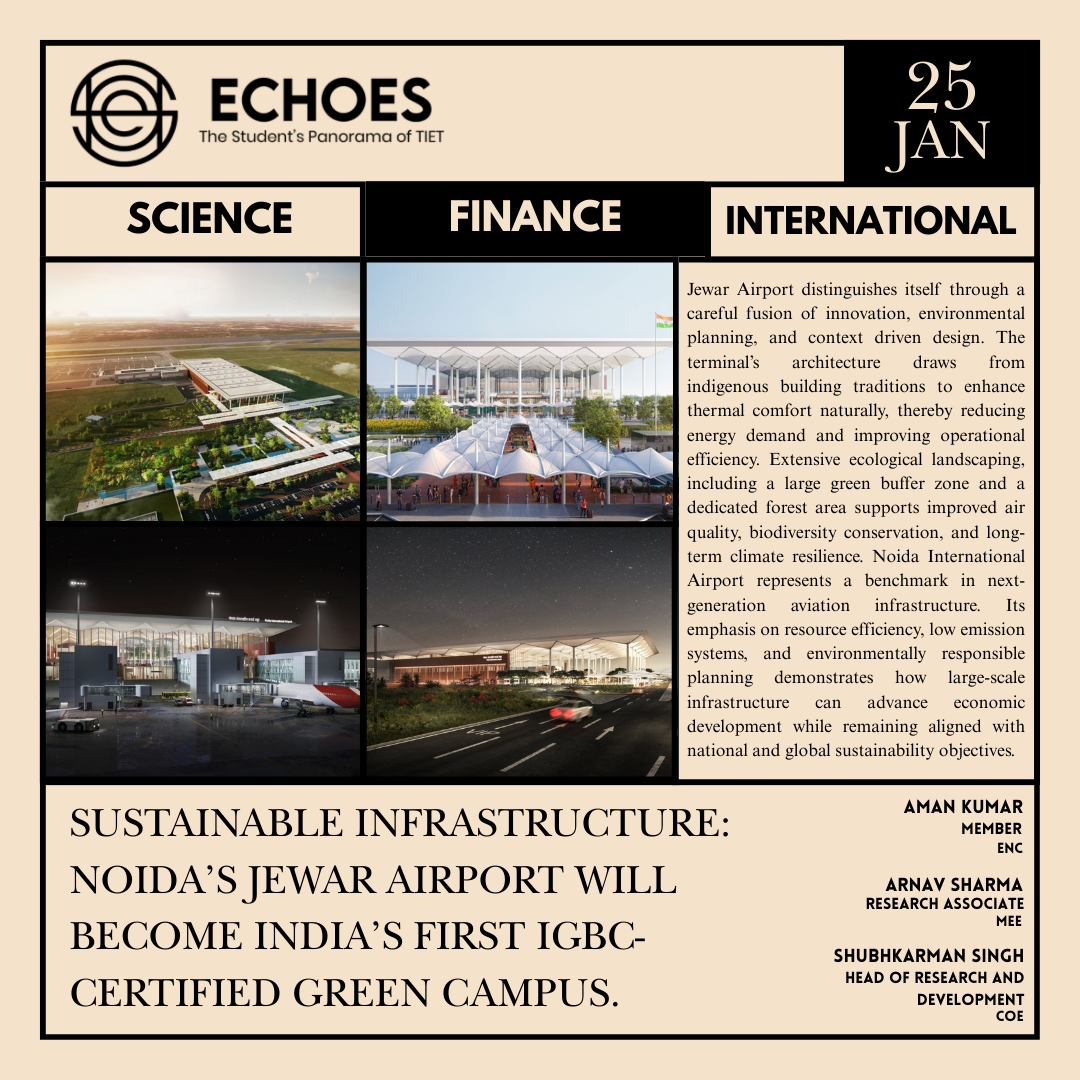
As we move into early 2026, the launch of the Noida International Airport (NIA) in Jewar is officially more than just an infrastructure milestone—it is a massive win for sustainability. NIA has just secured the IGBC Green Campus certification, making it the first project of this scale in India to be recognized for its entire 1,334-hectare ecosystem. Developed as a partnership between the UP government and Zurich Airport International, this is not just a place to catch a flight; it is a living "Net-Zero" case study. Here is a breakdown of why this matters for the future of Indian aviation:
A Massive Solar Footprint: The airport is anchored by an 82.94-acre solar farm with a generation capacity of over 51,000 megawatt-hours, enabling operations to run primarily on renewable energy. This clean power backbone effectively decouples airport growth from the conventional power grid and significantly reduces carbon emissions from the outset, positioning Jewar Airport as a low-carbon aviation hub.
100% Electric Airside Operations: In a first for Indian airports, the entire airside where aircraft park, taxi, and are serviced will operate on electric mobility. All baggage tugs, passenger shuttles, and ground service vehicles are battery-powered, supported by a dense network of charging stations embedded across the tarmac, ensuring efficient, emission-free ground operations.
Rethinking the Commute: To promote sustainable passenger mobility, 20% of the airport’s parking capacity is reserved for electric vehicles and equipped with standard and fast-charging facilities. Future-ready plans such as pod taxis and a dedicated rapid rail–metro corridor aim to reduce reliance on private vehicles, making low-emission public transport the preferred mode of access to the airport.
Circular Waste & Water Neutrality: The Jewar Airport campus has been designed as a self-sustaining ecosystem with a strong emphasis on circular resource management. It incorporates two large rainwater harvesting ponds to capture and store runoff, significantly reducing dependence on external water sources. A zero-liquid discharge Sewage Treatment Plant (STP) ensures that all wastewater generated on campus is treated and reused. Additionally, an on-site Renewable Natural Gas (RNG) plant converts organic waste into clean fuel for ground vehicle and emergency backup systems. Together, these systems establish a closed-loop model for water and waste management, reinforcing the airport’s commitment to water neutrality, waste minimization, and long-term environmental resilience.
Sources: economictimes.com