The Islamabad Accord: A Fragile Pause in United States–Iran Tensions
By Aryan Malik
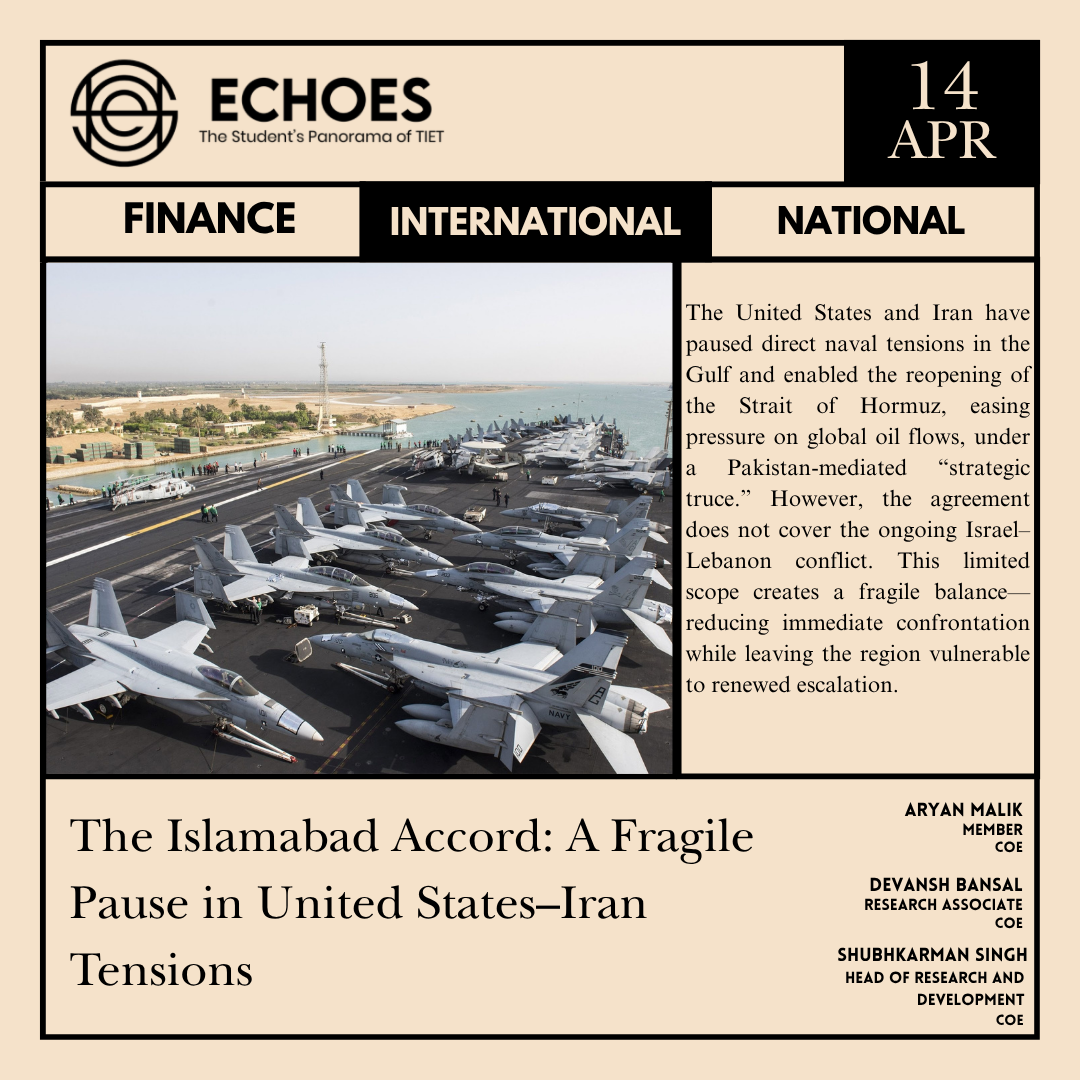
On 9 April 2026, the United States and Iran reached a high-stakes “strategic truce” in Islamabad after 11 hours of negotiations, marking a rare pause in direct hostilities following weeks of naval confrontations. Brokered by Pakistan, the agreement focuses on de-escalation in the Gulf, with Iran committing to restoring safe passage through the Strait of Hormuz, including the sharing of maritime data on sea mine zones. The move comes after significant disruption to regional energy flows, with nearly 17% of Qatar’s LNG capacity reportedly affected. While the agreement emphasizes de-escalation, Iran is understood to have sought constraints on external naval presence in the Gulf, indicating partial alignment rather than full strategic convergence.
Yet, the accord’s limitations are as significant as its breakthroughs. It explicitly excludes the Lebanon front, where Israel’s ongoing military operations continue unabated. Within hours of the announcement, Israeli strikes in Beirut reportedly killed a senior Hezbollah figure, underscoring how the conflict remains active beyond the truce’s scope. Israel’s campaign against Hezbollah continues amid rising cross-border tensions, reinforcing escalation beyond the truce’s scope. Tehran has accused Washington of using the truce as a “strategic shield” for allied operations. At the same time, the U.S. maintains that the Lebanon theatre involves non-state actors and falls outside its bilateral engagement with Iran. This exclusion creates a fragmented security dynamic, where direct US–Iran tensions are paused, but proxy conflict persists, leaving the broader region unstable.
Economically, the reopening of Hormuz offers short-term relief to global energy markets and Gulf economies. Strategically, however, the agreement entrenches a fragmented regional security order. By isolating US–Iran tensions from the broader Israel–Hezbollah conflict, the truce sustains a pattern of “controlled escalation” rather than resolving underlying instability. While Pakistan’s mediation provides a critical diplomatic off-ramp, the absence of a wider regional ceasefire leaves the situation highly susceptible to rapid re-escalation.
Source: bbc.com, reuters.com,