The Zojila Breakthrough: Annexing the Himalayan Winter and the New Ladakh Paradigm
By Aryan Malik
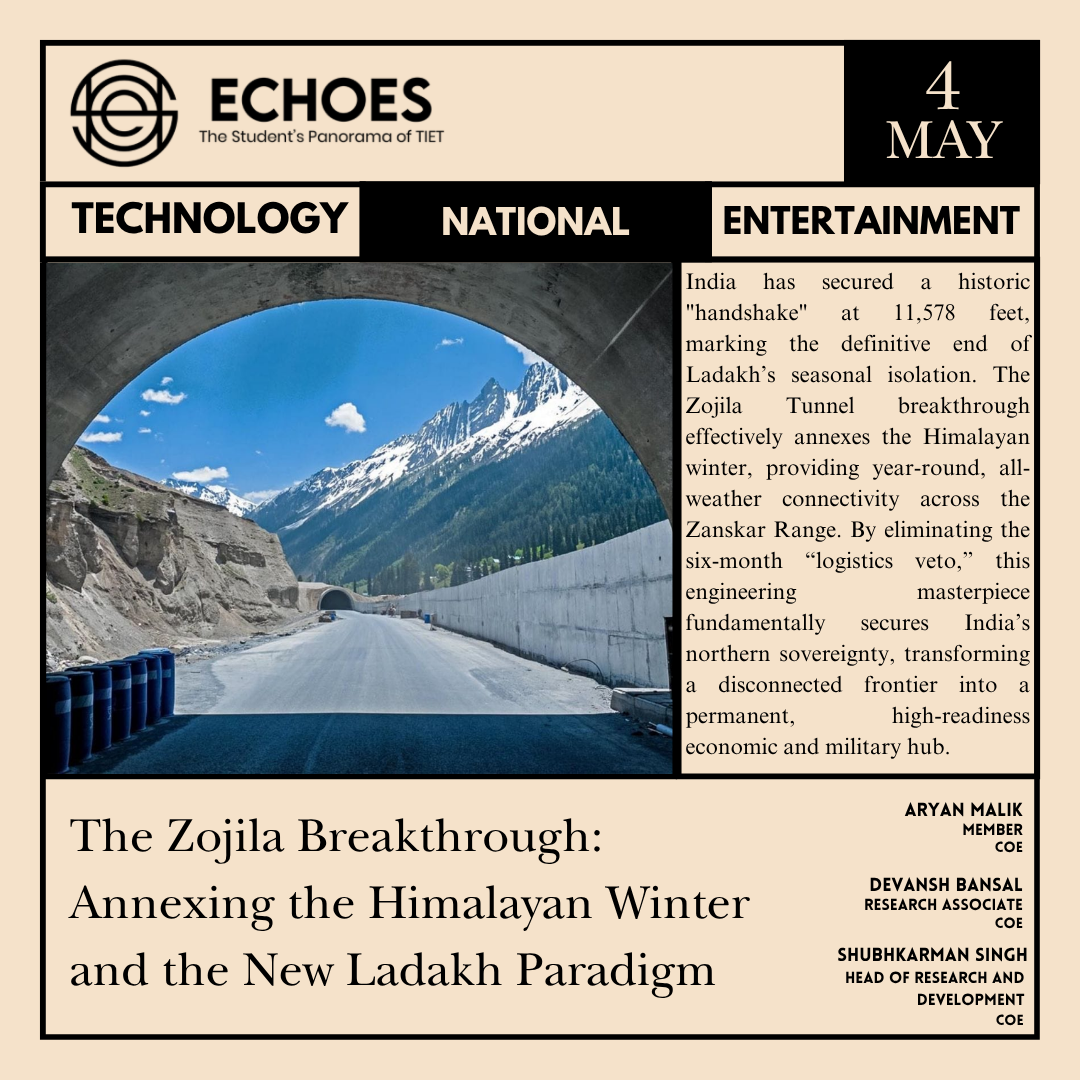
Zojila Tunnel Breakthrough: Redefining Connectivity and Strategy in the Himalayas
On 2 May 2026, the Ministry of Road Transport and Highways (MoRTH) announced that the Zojila Tunnel project has entered its definitive final phase, with the historic "handshake"—the physical connection of the two excavation fronts—expected by May 30.
Currently, engineers from Megha Engineering and Infrastructures Ltd (MEIL) are working in sub-zero temperatures at an altitude of 11,578 feet, with less than 300 meters of rock remaining in the 13.15 km horseshoe-shaped tube.
Once the final blast occurs, the project will officially become Asia’s longest bi-directional tunnel at high altitude, bypassing the treacherous Zojila Pass. This pass traditionally shuts for nearly six months every year, effectively severing the Srinagar–Leh highway and isolating the Ladakh region from the rest of the Indian mainland.
Engineering Breakthrough in the Himalayas
The technical execution of the project marks a significant leap in Himalayan engineering. Utilizing the New Austrian Tunneling Method (NATM) and advanced SCADA (Supervisory Control and Data Acquisition) systems, the tunnel is designed to facilitate a 15-minute transit, down from the current 3.5-hour journey across the pass.
The structural integration includes a semi-transverse ventilation system and specialized avalanche-protection galleries, both necessitated by the complex geology of the Zanskar Range. Unlike standard infrastructure projects, the Zojila Tunnel is being built with a 0.99 reliability factor for extreme weather.
This ensures that even during record-breaking snowfall, the flow of heavy military convoys and civilian logistics remains "unimpeded".
Strategic and Economic Impact
The implications of this breakthrough are both military and socio-economic. Strategically, the tunnel "annexes the winter", providing the Indian Army with year-round kinetic mobility along the Line of Actual Control (LAC) and the Line of Control (LoC).
By removing the seasonal "logistics veto" imposed by the weather, India can now sustain a permanent, high-readiness posture without the massive cost of winter air-stockpiling.
Economically, the tunnel serves as a "Structural Shield" for the Ladakh region, transforming it from a seasonal outpost into a year-round economic hub.
While the full commissioning is slated for September 2026, this month’s breakthrough represents the final death knell for Ladakh’s winter isolation, fundamentally redefining the sovereign geography of the North.
Sources: hindustantimes.com, pib.gov.in